In the context of Industry 4.0 rapidly evolving in Vietnam, the adoption of industrial robots is no longer a future trend—it has become an essential solution to boost productivity, ensure safety, and reduce operational costs.
However, robots alone cannot deliver maximum efficiency if they operate in isolation. The true breakthrough comes from integrating industrial robots (such as lift robots, autonomous mobile robots, towing robots, industrial cleaning robots, etc.) with operational management systems such as WMS, RCS, and IoT platforms.
This integration is the key for enterprises to transition from “local automation” to holistic, end-to-end automation (Integrated Automation).
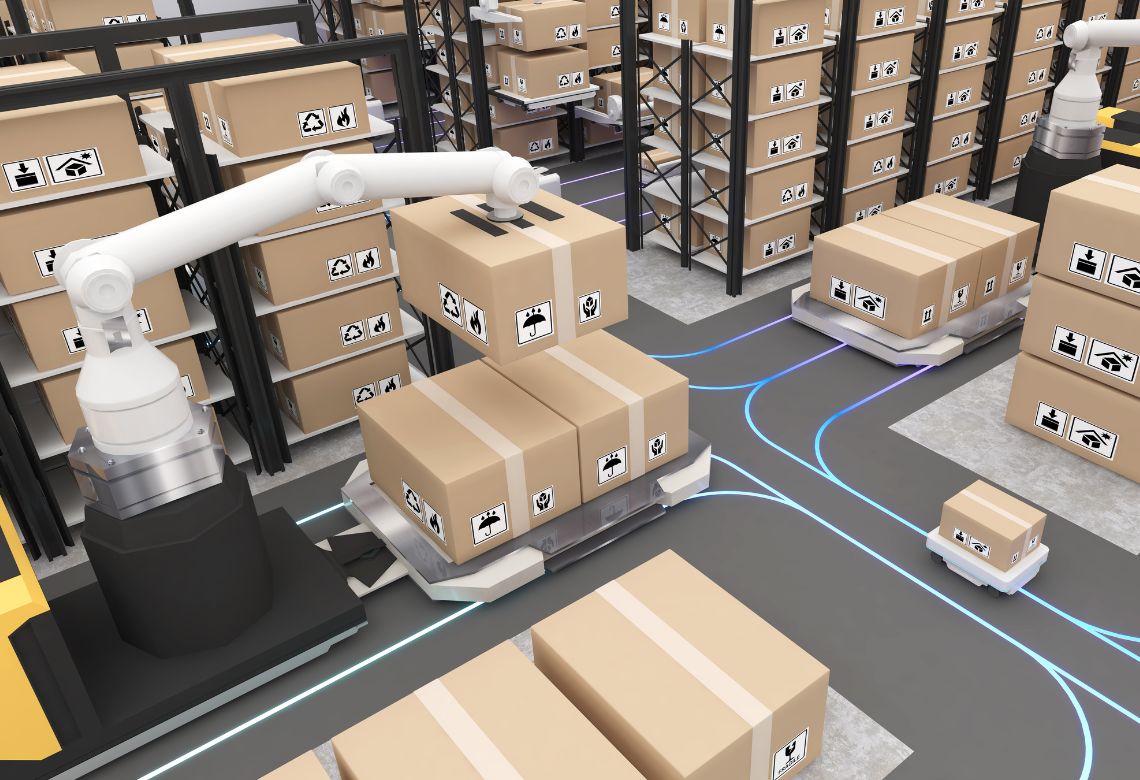
From Standalone Robots to a Fully Connected Automation Ecosystem
In the past, industrial robots were often deployed as isolated devices:
– A single AMR transporting materials between production lines
– A lifting robot transferring goods across floors
– A cleaning robot operating on a fixed schedule
However, when these robots do not communicate with each other or with a central management system, automation efficiency reaches only a fraction of its true potential.
The new generation of industrial operations is defined by connecting all robots and equipment into an intelligent, unified ecosystem, creating a fully automated internal logistics flow.
Types of Industrial Robots in a Smart Factory Ecosystem
• Autonomous Mobile Robots (AMR/AGV)
Used to transport materials between warehouses, production lines, and packing areas. When integrated with WMS and RCS, AMRs can:
– Automatically receive tasks based on real-time inventory
– Optimize routes to avoid congestion
– Synchronize delivery status with ERP systems
• Lifting Robots
Self-driving lifting units that handle storage, retrieval, and pallet movement in multi-level warehouses. Integrated with RCS, they can:
– Receive real-time control signals
– Coordinate priority with other robots
– Operate safely within restricted or high-density environments
• Cleaning & Inspection Robots
In high-traffic warehouses and factories, robots dedicated to floor cleaning or inspection maintain a safe and clean operational environment. Their movement, performance, and condition data are synchronized with IoT platforms.
Core Operational Management Systems: WMS, RCS, IoT
WMS – Warehouse Management System
The central database for stock levels, locations, and material flow. When integrated with robots:
– WMS automatically assigns tasks to AMRs
– Sends pick/put instructions based on pallet location
– Updates ERP/MES in real time
RCS – Robot Control System
The “brain” coordinating all robot activities:
– Assigns routes, avoids collisions, manages traffic
– Controls multiple robot types simultaneously
– Enhances navigation using IoT sensors or AI cameras
IoT – Internet of Things
The data layer linking all devices across the facility:
– Each robot/sensor has a unique ID transmitting live status
– Managers can monitor performance, battery, maintenance, routes
– AI analytics predict failures and optimize efficiency
Benefits of Integrating Robots With Operational Management Systems
| Category |
Before Integration |
After Integration |
| Automation Level |
Isolated robot operation |
Synchronized end-to-end automation |
| Efficiency |
Manual task assignment |
WMS-driven automatic dispatching |
| Safety & Accuracy |
Potential navigation errors |
Real-time collision avoidance via RCS |
| Data Management |
Fragmented or missing data |
Centralized IoT analytics |
| Maintenance |
Reactive, experience-based |
Predictive, sensor-driven alerts |
Real-World Applications in Smart Warehouses & Factories
– AMRs integrated with automated lifting systems for seamless multi-level goods movement
– RCS optimizing robot routes and coordinating cleaning robots with transport robots
– IoT platforms recording operational logs, energy use, and maintenance cycles
– Predictive analytics reducing robot downtime by up to 20–30%
Pan Trading JSC – Integrated Automation Solution Provider
With extensive experience in industrial equipment and partnerships with global robotics manufacturers, Pan Trading JSC offers comprehensive solutions for smart warehouses and factories:
– Autonomous mobile robots, lifting robots, cleaning robots, and robotic forklifts
– Consulting and integration of RCS – WMS – IoT platforms
– Full deployment supported by engineers trained by leading robotics brands
Conclusion
Integrating industrial robots with operational management systems is not just a technological upgrade—it is the foundation of modern smart operations.
When every device can communicate, share data, and work in harmony, businesses achieve higher productivity, better safety, and long-term operational resilience.
Pan Trading JSC is proud to accompany Vietnamese enterprises on their journey toward end-to-end automation.